
The Vision Behind ONBD.AI
The next evolution in ship bridge navigation infrastructure. Modern ship bridges are becoming increasingly sophisticated.
Radar, ECDIS, AIS, gyro systems, VDRs, autopilots and other navigation technologies collectively form one of the most critical technology environments onboard a vessel. These are not simply pieces of equipment—they are interconnected systems supporting safe navigation and vessel operations.
Yet the way much of this equipment is maintained remains surprisingly traditional.
A problem occurs. The vessel reports it. The shore team investigates. A service engineer is contacted. Previous service reports are searched. Spare parts are identified. Attendance is arranged.
In many cases, valuable technical information already exists—but it is fragmented across vessels, manufacturers, service reports, emails, survey records and different systems.
We believe there is a better way.
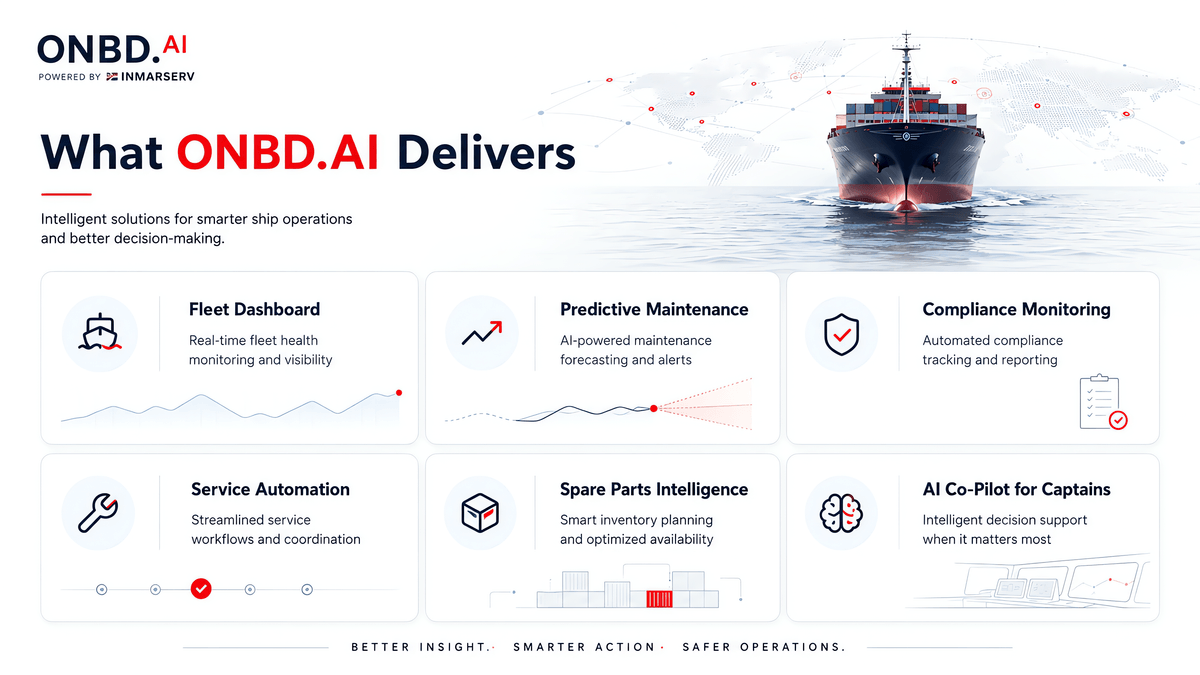
The vision is straightforward:
What if every vessel's bridge could have an intelligent digital layer continuously helping ship and shore teams understand equipment condition, service requirements, compliance obligations and emerging technical risks?
Rather than waiting for equipment problems to become service events, ONBD.AI is intended to help operators move progressively toward proactive and predictive equipment management.
Built from maritime engineering experience. ONBD.AI is not starting with AI and looking for a maritime problem to solve.
Built from maritime engineering experience. ONBD.AI is not starting with AI and looking for a maritime problem to solve.
It is being developed from the operational experience of the INMARSERV team, which today digitalizes and coordinates bridge navigation services, surveys and technical requirements across a pool of more than 1200 vessels annually.
Working alongside shipowners, vessel teams, service companies and equipment specialists has given us an important perspective:
The industry's real opportunity is not simply to digitize service arrangements. It is to turn years of equipment, service and operational knowledge into actionable intelligence.
A radar service report should not disappear into an archive after an engineer leaves the vessel.
An ECDIS issue on one vessel should potentially contribute to understanding similar equipment across the fleet.
Recurring faults, equipment age, service history, survey requirements, spare-parts information and manufacturer knowledge should collectively help operators understand what may require attention next.
That is the intelligence layer ONBD.AI aims to build.
Knowing what is likely to happen, why it matters and what should be done next is considerably more valuable.
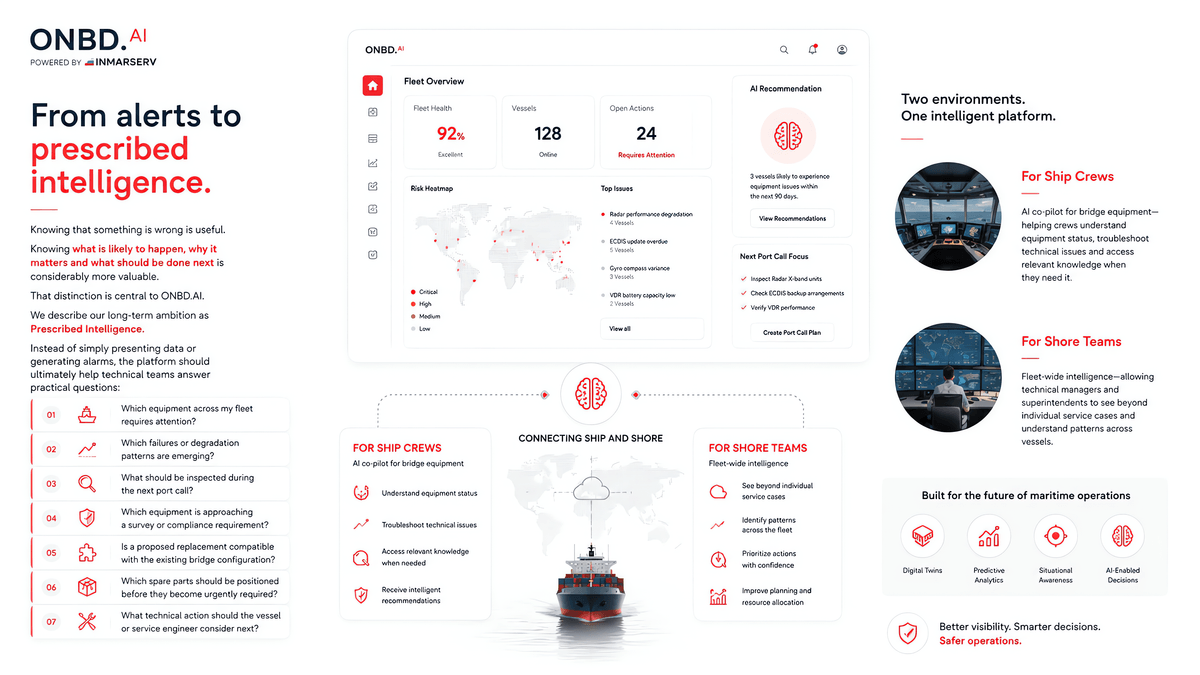
Connecting ship and shore. ONBD.AI is being designed around two environments.
For ship crews, the ambition is to provide an AI co-pilot for bridge equipment—helping crews understand equipment status, troubleshoot technical issues and access relevant knowledge when they need it.
For shore teams, ONBD.AI can provide fleet-wide intelligence, allowing technical managers and superintendents to see beyond individual service cases and understand patterns across vessels.
A fleet manager should eventually be able to move from asking:
"Which vessels currently have open navigation equipment problems?"
to:
"Which vessels are most likely to require intervention during the next six months, and what should we do now?"
That is a fundamentally different approach to fleet technical management.
Human expertise remains essential
ONBD.AI is not intended to replace captains, superintendents, navigation officers, service engineers or equipment specialists. Maritime operations demand professional judgement. The objective is to give those professionals better information, earlier visibility and stronger decision support.
AI can analyse large quantities of equipment information and identify patterns that would be difficult to recognise manually. But experienced maritime professionals remain responsible for interpreting operational circumstances and making critical decisions. The strongest maritime AI will therefore not replace expertise. It will amplify it.
Building ONBD.AI together with shipowners
We believe a platform like ONBD.AI should not be developed in isolation.
We are now working with selected shipowners and ship managers through joint development and pilot projects. Over the coming months, we intend to collaborate with fleet operators, technical managers, vessel crews, equipment manufacturers and service specialists to validate real-world use cases and determine where intelligence can create the greatest operational value.
Our ambition is significant:
To create an intelligent operating layer for ship bridge navigation infrastructure—connecting equipment, vessels, shore teams, engineering knowledge and AI.
The maritime industry has spent decades installing increasingly intelligent equipment onboard ships. Perhaps the next step is to make the entire bridge infrastructure intelligent.
www.onbd.ai
From bridge data to prescribed intelligence.